
editorial-rewrite-live
-
PFAS in Tap Water: Filtering, Certification, and Maintenance
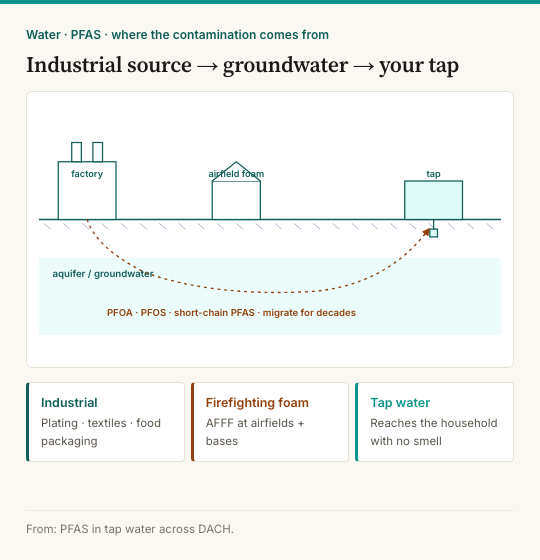
Key Takeaways Per- and polyfluoroalkyl substances (PFAS) are a large family of synthetic chemicals that accumulate in the body over time, and standard water treatment does not remove them. The good news: the same filter technologies that remove PFAS also improve taste, reduce chlorine, and address other water-quality concerns. A good PFAS filter is a…
-
LED Flicker at Home: Dimmers, Drivers, and Steadier Light
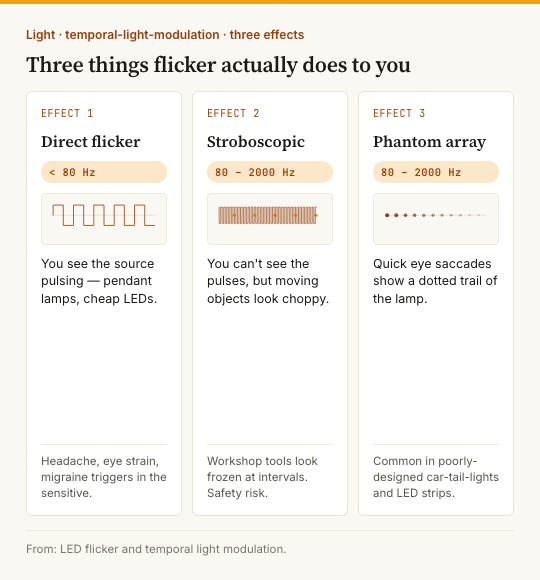
Key Takeaways When you switch to LED, you gain control over several things at once: colour temperature, how the light renders skin and food, and how steady it is when dimmed. Flicker is part of that last quality, and it is almost always fixable. Two numbers on quality LED bulb specs tell you how steady…
-
Circadian Lighting at Home: Melanopic EDI and the Three Targets
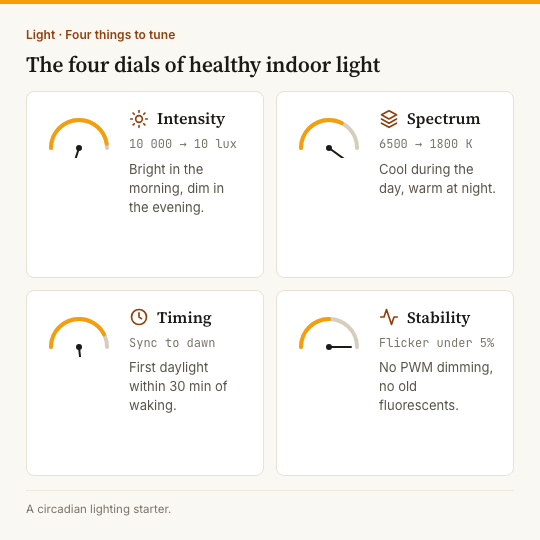
Key Takeaways Most homes are too dim during the day and too bright in the evening. The body uses light as a daily timing signal, and the rhythm matters as much as the numbers. Brightness (lux) alone does not tell the full story. The quality of the light — specifically which wavelengths it contains —…
-
Heart Rate Variability: Measuring the Autonomic Nervous System

Key Takeaways HRV is a measurement, not a wellness score. It is a summary statistic of autonomic activity with standardised time- and frequency-domain definitions published in 1996. Two autonomic branches write different rhythms into the heartbeat. The parasympathetic (vagal) branch dominates the high-frequency band (0.15–0.40 Hz); the sympathetic branch dominates the low-frequency band (0.04–0.15 Hz).…
-
Heliobiology: Resonance Between Solar Activity and Health
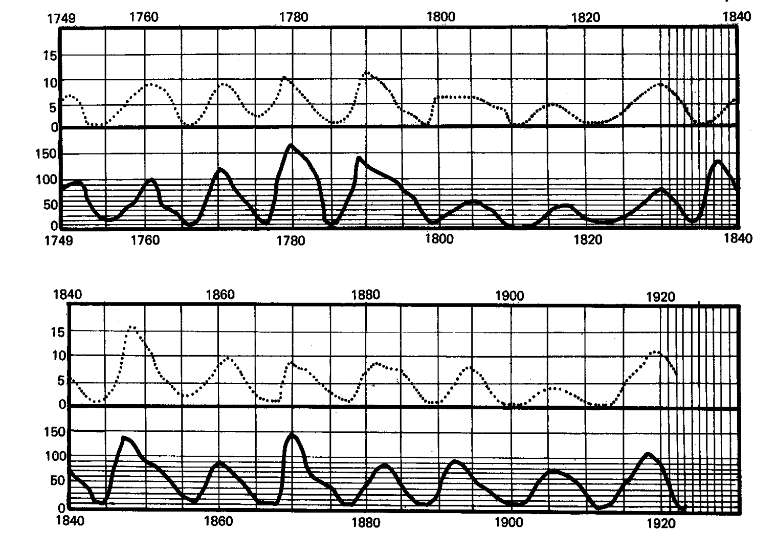
Key Takeaways Heliobiology studies whether rhythms of solar and geomagnetic activity leave measurable traces in human physiology. Its observational arc runs from Alexander Tchijevsky’s 1920s historiometry to the post-satellite era of space-weather correlation studies. The core mechanistic puzzle is amplitude. A strong geomagnetic storm perturbs only about one percent of the steady background field, orders…
-
Health Physics: The Role of Energy in Our Body

I am a medical physicist. Most of my working week is spent managing ionising radiation — X-rays, gamma sources, fluoroscopy. The discipline that governs that work is called health physics, and for most of its history it has meant keeping doses within safe bounds for patients and staff — an accurate description, but a much…
-
Solar and Geomagnetic Parameters: Six Indices for Tracking the Solar Cycle

Key Takeaways Multiple solar and geomagnetic parameters change systematically across the 11-year solar cycle — and each can be tracked with real-time or near-real-time data. Total Solar Irradiance barely changes across the cycle. Shortwave radiation (especially EUV) varies by orders of magnitude and drives most of the cycle’s effects on Earth’s atmosphere. Schumann resonances —…
-
Space Weather: How Solar Activity Reaches Earth

Key Takeaways Space weather is the changing condition of near-Earth space driven by solar activity — solar wind, flares, and coronal mass ejections. Earth’s magnetosphere shields the planet from the solar wind, but strong events compress it and trigger geomagnetic storms. Geomagnetic storms last 1–5 days and typically reach about 100 nT in field disturbance;…
-
Solar Cycles: The Schwabe Rhythm and Longer Solar Variations

Key Takeaways The 11-year sunspot cycle is one of the most reliably documented patterns in astrophysics. It has been tracked continuously by international observatories since 1849. The full magnetic cycle is 22 years, not 11. Solar polarity reverses at each solar maximum, so a complete magnetic rotation spans two activity cycles. Solar activity operates across…
-
Sunspots and Their Origin: Magneto-Convection on the Solar Surface
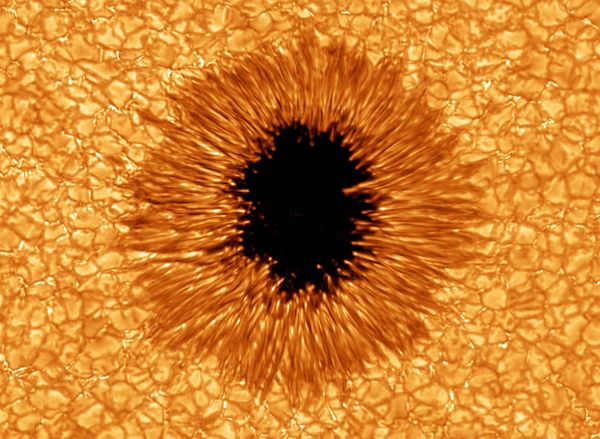
Key Takeaways Sunspots form when strong magnetic fields suppress convection in the Sun’s outer layer, producing cooler, darker regions on the surface. Magneto-convection — the interaction between solar plasma and the magnetic field — drives both sunspot formation and solar flare activity. Sunspots can span up to 160,000 km in diameter and persist anywhere from…