
general
-
Solar and Geomagnetic Parameters: Six Indices for Tracking the Solar Cycle

Key Takeaways Multiple solar and geomagnetic parameters change systematically across the 11-year solar cycle — and each can be tracked with real-time or near-real-time data. Total Solar Irradiance barely changes across the cycle. Shortwave radiation (especially EUV) varies by orders of magnitude and drives most of the cycle’s effects on Earth’s atmosphere. Schumann resonances —…
-
Space Weather: How Solar Activity Reaches Earth

Key Takeaways Space weather is the changing condition of near-Earth space driven by solar activity — solar wind, flares, and coronal mass ejections. Earth’s magnetosphere shields the planet from the solar wind, but strong events compress it and trigger geomagnetic storms. Geomagnetic storms last 1–5 days and typically reach about 100 nT in field disturbance;…
-
Solar Cycles: The Schwabe Rhythm and Longer Solar Variations

Key Takeaways The 11-year sunspot cycle is one of the most reliably documented patterns in astrophysics. It has been tracked continuously by international observatories since 1849. The full magnetic cycle is 22 years, not 11. Solar polarity reverses at each solar maximum, so a complete magnetic rotation spans two activity cycles. Solar activity operates across…
-
Sunspots and Their Origin: Magneto-Convection on the Solar Surface
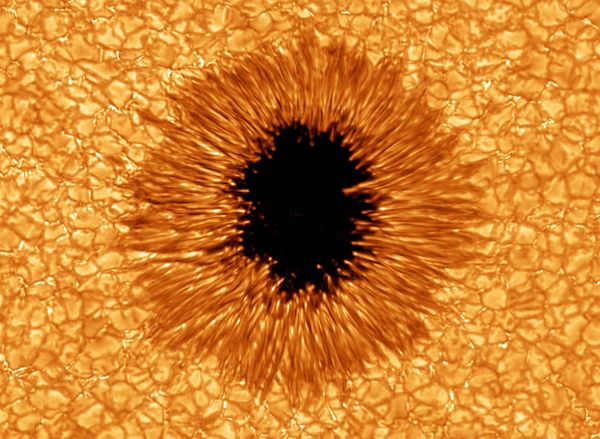
Key Takeaways Sunspots form when strong magnetic fields suppress convection in the Sun’s outer layer, producing cooler, darker regions on the surface. Magneto-convection — the interaction between solar plasma and the magnetic field — drives both sunspot formation and solar flare activity. Sunspots can span up to 160,000 km in diameter and persist anywhere from…