
The Sun’s magnetic field reaches thousands of kilometers beyond its surface and speeds up particles way beyond its atmosphere. These energetic particles can leave the Sun and travel to other planets in the solar system carried by the solar wind.
Furthermore, the solar magnetic field holds a lot of magnetic energy. Sometimes, rapid changes lead to bursts of energy. The twisting and crossing of magnetic lines near Sunspots can create solar flares that release intense radiation into space. These flares are sometimes followed by a coronal mass ejection (CME). A CME sends out large amounts of solar plasma into space (Sami K Solanki, Inhester, & Schüssler, 2006).
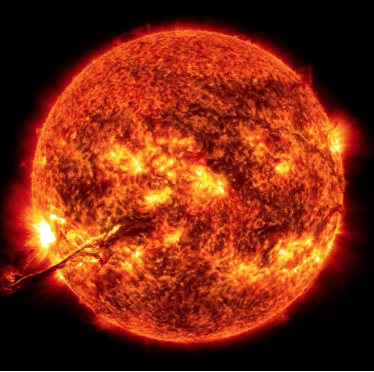
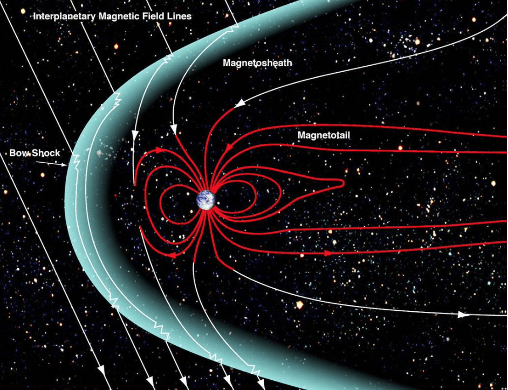
The interactions between solar wind, the interplanetary magnetic field, and Earth’s magnetic field are complicated. They shape Earth’s magnetosphere, which starts at the outer layer of the atmosphere, called the thermosphere. After reaching the magnetosheath, the pressure from the solar wind is balanced by Earth’s magnetic field. This interaction distorts Earth’s magnetic field into a bow shape toward the Sun. On the opposite side, there is a long magnetotail. When the solar wind is weak, the magnetosphere expands; when strong, it compresses and penetrates deeper, causing space weather effects. For example, geomagnetic storms happen when the Sun emits a coronal mass ejection (CME). This pushes a shock wave toward Earth, which results in intense geomagnetic activity and auroras.
A geomagnetic storm begins with a quick rise in the magnetic field. This phase lasts a few hours. It is followed by a swift drop. Then, the magnetic field intensity begins to recover, first quickly and then slowly. Magnetic storms can last from 1 to 5 days. They usually reach about 100 nT field strength, while storms exceeding 500 nT happen every few years (Kivelson, Kivelson, & Russell, 1995).
Space weather events can harm satellite technology and the Earth’s power grid, and they have also been linked to negative health effects (Kiznys et al., 2020; Vencloviene, Braziene, & Dobozinskas, 2018). The authors observed an increase in emergency ambulance calls for coronary syndrome and higher arterial blood pressure during these events. Space weather events happen more often during solar maxima and are correlated to the number of sunspots (D. H. Hathaway, 2015).
 SOLARHEALTH
Leave a reply to The Science Behind Sunspots – SOLARHEALTH Cancel reply