
Several important features of the Sun and its effects on Earth vary during the Solar Cycle. These are observed from the ground or satellites near Earth. They help us understand the Sun-Earth connection. They are essential for understanding how solar activity relates to health. It is crucial to acknowledge their importance and their implications for interpreting these relationships.
Solar Irradiance
The Total Solar Irradiance (TSI) is the total amount of sunlight that hits us. It is measured by satellites outside Earth’s atmosphere, but during the solar cycle it does not change a lot. Now, on the flip side, shortwave spectral irradiance in the infrared and gamma range is just a tiny slice of that spectrum. It’s almost all absorbed by the upper Earth’s atmosphere (ionosphere). This absorption creates electrical modifications in Earth’s ionosphere, which are important for the Schumann Resonances in Heliobiology. During the solar cycle, shortwave irradiance can swing way more than TSI . For example, Extreme Ultraviolet irradiance (EUV) can vary 1000 times more during the cycle than TSI. This means that the corresponding ionosphere’s electrical modifications and Schumann Resonances vary significantly, too.
| Solar Irradiance Component | Energy Flux | Solar Cycle Change | |
| TSI (mostly Visible & Infrared) | 1366 W/m2 | 1.2 W/m2 | 0.1% |
| MUV(200-300 nm) | 15.4 W/m2 | 0.17 W/m2 | 1% |
| FUV (126-200 nm) | 50 mW/m2 | 15 mW/m2 | 30% |
| EUV (0-125 nm) | 10 mW/m2 | 10 mW/m2 | 100% |
The shortwave irradiance originates primarily from the hotter layers of the Sun’s atmosphere. In these layers, higher temperatures shift the solar spectrum to shorter wavelengths. The solar atmosphere is very dynamic. It is influenced by changes in solar magnetic activity. This influence causes significant variations in EUV and X-ray flux throughout the solar cycle.

Atmospheric Ionization and Schumann resonances
Ultraviolet (UV) radiation helps produce ozone in the stratosphere, which protects life on Earth. EUV radiation creates the thermosphere and influences the electrical conductivity of the magnetosphere, particularly the ionosphere. The energy contribution from UV-emissions is small compared to Total Solar Irradiance (TSI). However, it significantly affects the atmosphere due to its ionizing properties. This is key in one of the main biophysical processes studied in heliobiology: atmospheric resonances.

The ionosphere is a conductive plasma layer that reflects radio waves, allowing for “skywave” communication. It is also responsible for a natural phenomenon called Schumann resonance. This resonance occurs between Earth’s surface and the ionospheric D-region, with the main Schumann resonance mode at 7.83 Hz representing a standing wave that matches Earth’s circumference. Higher harmonics up to around 60 Hz can also be detected.
Schumann resonances are influenced by lightning around the world, which increases during solar minima (Heckman, Williams, & Boldi, 1998). Additionally, solar changes affect the ionosphere. They alter the upper boundary shape, impacting the frequencies and intensity of Schumann resonances. As a result, Schumann resonances strongly correlate with solar activity. These resonances are similar to brain wave patterns. Therefore, they are expected to play a key role in affecting health conditions due to solar variations (Persinger, 2014). See also this post for more details on their health impact.
Beside Schumann resonances, Solar Wind resonances in the magnetospheric cavity produce ultra-low frequencies between 0.001 –1 Hz. These frequencies can biologically be related to heart frequencies. This indicates another type of natural resonance to influence biological processes.
Geomagnetic activity
Geomagnetic activity on Earth is heavily affected by solar dynamics. Even though during solar minima high levels of geomagnetic activity can be observed, this activity increases significantly during solar maxima. However, the relationship is not straightforward due to various interactions between the magnetosphere and the heliosphere (D. H. Hathaway, 2015).

Space Weather
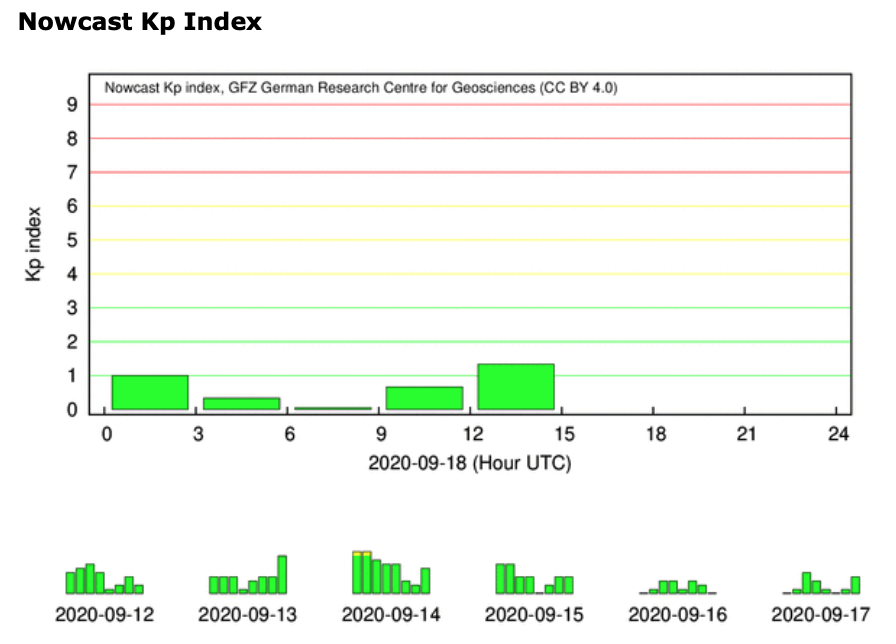
The Kp-Index measures short-term changes in the Earth’s horizontal magnetic field. It is based on the aa-Index, which shows geomagnetic field strength. It is calculated every three hours from data collected at 13 magnetic observatories. The Kp-Index measures only fluctuations, not absolute values, as the usual quiet-day variation has been removed. These changes show irregular disturbances in the geomagnetic field caused by interactions with solar wind. Low Kp values signify calm geomagnetic conditions, while values of 5 or above show a geomagnetic storm.
Solar radio flux
The 10.7 cm wavelength of solar radiation (2800 MHz) measures the intensity of solar radio flux (F10.7), which is a good indicator of solar activity. Radio wavelengths can pass through both the Sun and Earth’s atmosphere. F10.7 is highly correlated with the Sunspot number. This correlation serves as a robust way to describe solar activity (Okoh & Okoro, 2019). F10.7 is measured in s.f.u. (“solar flux units”) and is one of the longest records of solar activity. Due to its low absorption rate in Earth’s atmosphere, it has been measured from the ground since 1947. Therefore, this measurement is especially useful for analyzing medical effects on the ground.
Galactic cosmic rays
Galactic Cosmic Rays are high-energy electrons and nuclei. They are different from solar particles, which are mostly protons at lower energies. The heliosphere acts as a protective shield, blocking charged particles from outside our solar system. When these charged particles enter Earth’s upper atmosphere, they cause showers of secondary particles. Some of these particles can be detected by ground-based neutron monitors located at high-altitude sites. Galactic Cosmic Rays show an inverse relationship with solar activity, meaning they are at their highest during solar minima.
 SOLARHEALTH
Leave a comment