
Astrophysically, our Sun is considered a cool star because it has a low surface temperature. This affects how heat moves from the inner core to the surface. In the outer 30% of the Sun, heat from nuclear reactions is mainly spread through convection instead of radiation. The mixing of solar plasma and the solar magnetic field creates a complex process called magneto-convection.
In solar magneto-convection, there are two cases. The magnetic forces can be weaker than the pressure from the turbulent plasma. In this situation, the movements in the plasma can twist and stretch the magnetic field lines. This process, known as dynamo action, strengthens the solar magnetic field. Sudden changes in the solar field lines can cause solar flares. These flares affect space weather events on Earth.
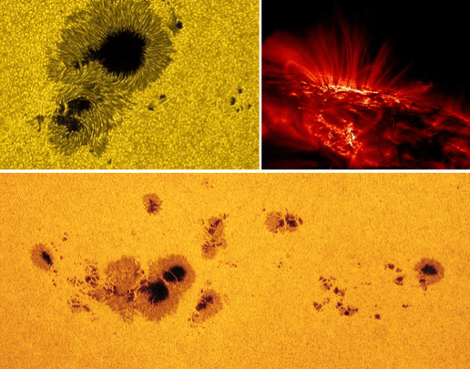
When the magnetic force is stronger than turbulent pressure, the solar magnetic field directs plasma motion along its lines. This prevents convection, leading to cold spots on the solar surface known as sunspots. These sunspots can reach diameters of up to 160,000 km and last from a few days to a few months (D. D. H. Hathaway, 2015). They appear dark due to their lower temperature, which is caused by inhibited convection. Their large size and contrast makes them easily visible from Earth.
 SOLARHEALTH
Leave a comment